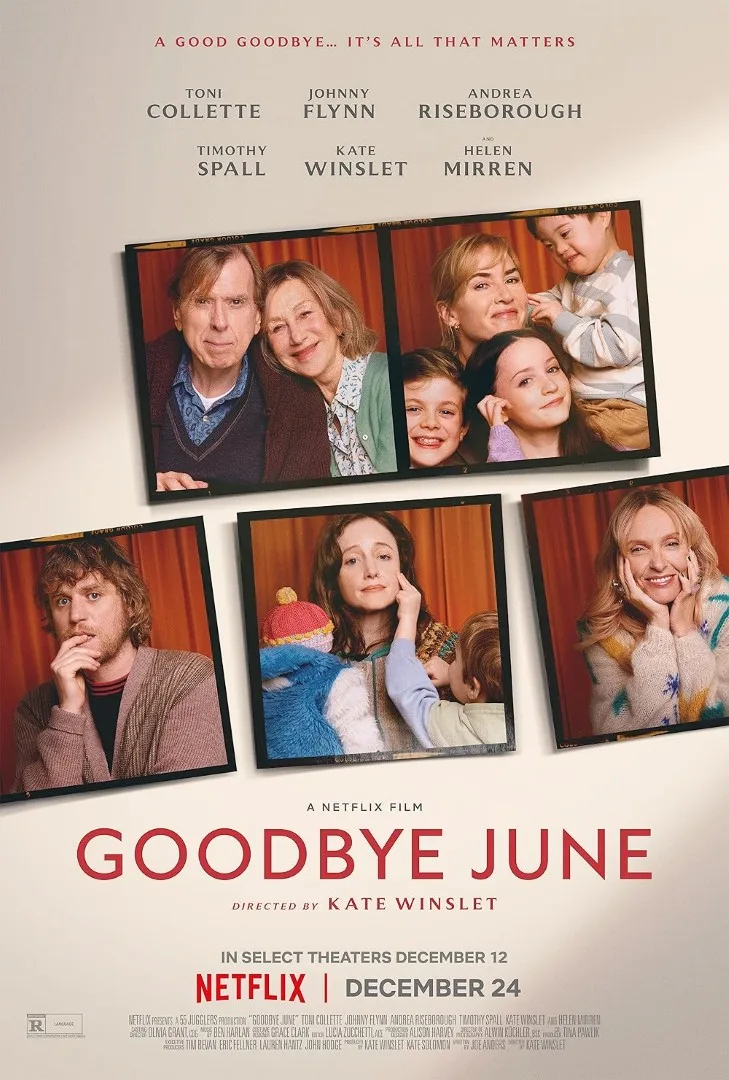
With an actress of Kate Winslet’s caliber, one would expect a bit more buzz about her first foray in directing. But news of her debut, “Goodbye June,” has been surprisingly scant. And unfortunately, post-release, it may continue to fly under the radar, as the film is formulaic and forgettable. One may wonder why such a lackluster script drew the eyes of an Oscar-winner to cut her directorial teeth, until you realize the screenwriter is Winslet’s own son. The whole film feels like a production of calling in favors, as the relatively hotshot cast it drew seems incongruent with its content: a clichéd story of a disordered family over the holidays.
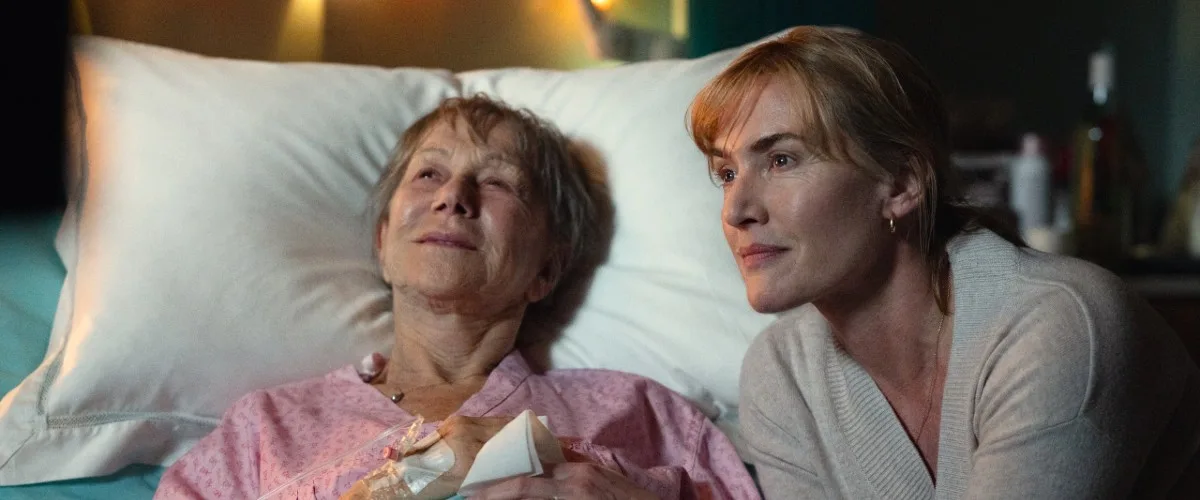
June (Helen Mirren) is dying. She likely won’t make it to Christmas, combining two of the great familial unifiers: death and holidays. And so, alongside her dry-humored husband Bernard (Timothy Spall), her children round up to be with her for one last yuletide season (albeit in the hospital), juggling their grief with their equally matched dysfunction.
Julia (Winslet) is a buttoned up workaholic who plays the part of the family “fixer”; Molly (Andrea Riseborough) is erratic and abrasive, weighed down by her resentments; Helen (Toni Collette) is a hippy-dippy caricature complete with blush-toned balayage and bundles of sage; and Connor (Johnny Flynn) is the sensitive youngest sibling, seemingly the only one who doesn’t redirect his sorrows.
If the plot sounds familiar, it’s because it is; there’s no shortage of dysfunctional family Christmas films. Still, this premise in particular–from the warring sisters to the impending death of a matriarch—bears a striking resemblance to another of Winslet’s films, 2019’s “Blackbird.”
But in seeing Winslet step behind the camera, she makes it apparent–in a blatant, expected sort of way–that this is an actor-turned-director’s film. Her style is pared back and at times textbook, primarily focusing on allowing the actors to work within the frame rather than on crafting any textured visual language. And the actors do all they can to buoy the film, certainly making themselves its most effective aspect. Riseborough’s spiteful neuroses and Flynn’s aching vulnerability are standouts, as well as Winslet’s suppressed pain. But the film’s highest level of tenderness comes from June’s nurse, played by Fisayo Akinade. Despite the on-the-nose nature of his eponym, Angel, his relationship with June, as well as his voyeurism into the family’s dynamics as he gently pulls strings towards resolution, is decently touching.
But the sentimentality of “Goodbye June” is also its Achilles’ heel. It tiptoes the line between manipulative and too tidy, with the tightrope itself being the center of mawkishness. It’s sickly sweet, even amidst witty banter (primarily from Spall’s one-liners) and genuine sincerity. Its earnestness can be effective, particularly a hallway heart-to-heart between Riseborough and Winslet that shows the film can find its footing when it zooms in on personal relationships and away from overly generalized, heartsick hoopla.
The sometimes-involuntary healing that accompanies pain and forced proximity is where “Goodbye June” finds a bit of light, but not enough to flood out the shadows of its hypersensitivity. It’s a simple film of an unremarkable ilk. Its unoriginal plot doesn’t immediately set it up for failure. Still, when combined with its bare-boned groveling, it falls flat more often than not, begging us for emotion that’d be more easily felt with a lighter hand.