Telling a story set in the past can be a great way to talk about the present. “Nuremberg” shows how. Director screenwriter James Vanderbilt‘s historical drama should be impossible to watch without thinking about the genocides, wars, and state repressions happening all over the world, and whether those responsible will ever be held accountable.
If you’re reading this review on the day it was published, you’re likely aware of the latest atrocities, including the kidnapping and detainment without trial of US citizens as well as immigrants by agents of the state. You will think about these crimes again while watching “Nuremberg,” because that sort of thing is discussed at some length—along with human rights violations, war crimes, and the process by which a state’s dehumanization of certain classes of citizen can lead to dictatorship, then genocide.
The title refers to the city where representatives of four Allied nations that teamed up to defeat Nazi Germany gathered to try its leaders. Concepts of international law and rules of war had been evolving for thousands of years by then. But the concept of “crimes against humanity” hadn’t been codified. Nor had the idea that a nation needn’t have signed a treaty to be bound by international practices. That framing of Nuremberg was controversial. There was large Allied faction that thought the Nazi leadership (and perhaps Nazis further down the ranks as well) should just be put against a wall and shot. That’s what usually happened to leaders of countries defeated in a war. It would’ve been faster and cheaper than a globally televised trial, and the architects of the first mechanized genocide wouldn’t have been able to twist media coverage of the event (including radio broadcasts) to spread their ideas.
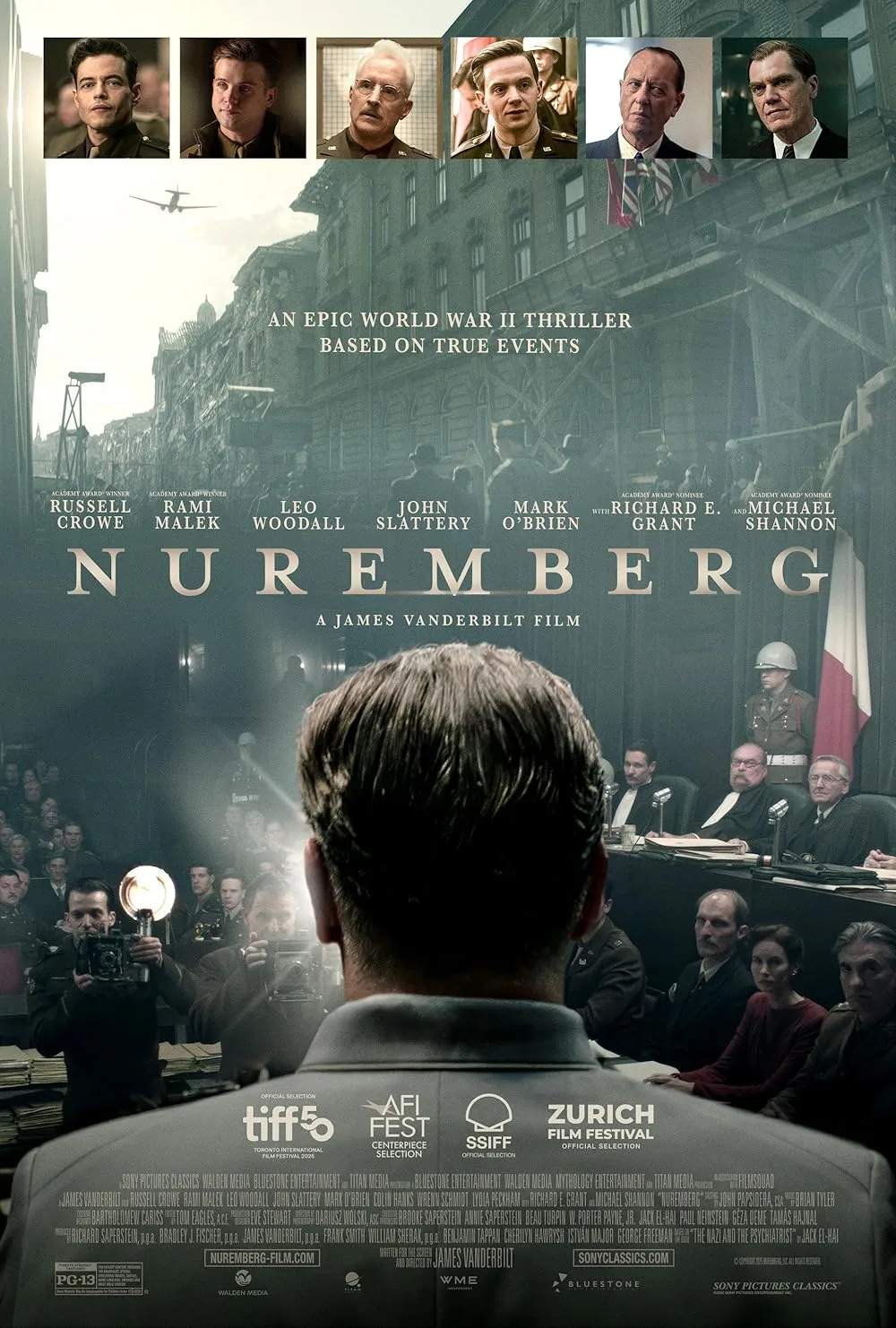
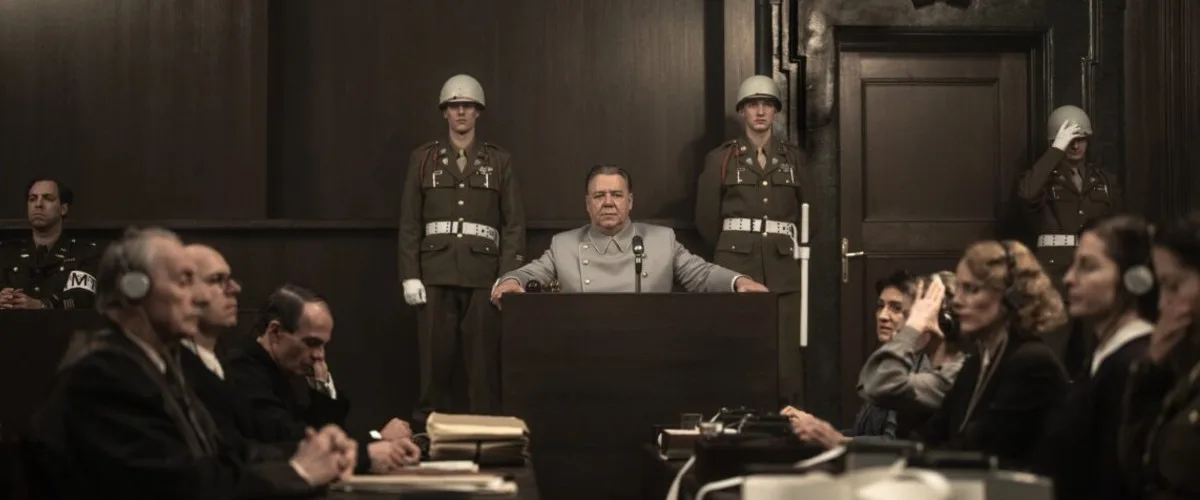
“Nuremberg” is based on The Nazi and the Psychiatrist, a nonfiction book by Jack El-Hai about the relationship between Hermann Göring (Russell Crowe), the highest-ranking surviving Nazi at Nuremberg, and American psychiatrist Jack Kelley (Rami Malek), who was brought to Nuremberg to evaluate imprisoned Nazi leaders and determine if they were fit to stand trial. As Smithsonian Magazine put it, Kelley wanted to “dissect evil” by determining “whether members of the Nazi high command shared a psychiatric condition that led them to commit unspeakable atrocities, the Holocaust chief among them.” Kelley got involved because there was an idealistic postwar push to make sure the men whose orders caused millions of deaths were held responsible for their actions. But his motives weren’t pure: he also figured he’d get a bestselling book out of the experience.
The movie begins with Göring’s arrest and gets us into the story by following the efforts of Supreme Court associate justice Robert H. Jackson (Michael Shannon) to convince President Harry Truman’s administration to try the Nazis. We get details about the Nuremberg prison and the courtroom; the then-recent history of Nuremberg, Germany and Europe; and the incremental escalation of crimes against state-decreed enemies. But the strange relationship between Kelley and Göring forms the spine of the story. Both actors are exceptional.
Crowe shows us why he’s one of the last great movie stars as well as a brilliant performer, settling into the high-powered character actor phase of his career as if it were a ratty old Barcalounger with a drink holder in each armrest. Like Gene Hackman in his greatest ’80s and ’90s performances, Crowe has such a regular-guy energy that on those rare occasions when Göring is thwarted or disappointed and we get a glimpse of his capacity for overwhelming violence, it somehow comes as an unsetting surprise within the context of the scene, even though we know the man’s a killer.
Malek got flak for his Oscar-winning performance as Freddy Mercury in “Bohemian Rhapsody,” not without justification. But he’d already proved he had the stuff to be an offbeat leading man in the satirical thriller “Mr. Robot,” which succeeded mainly because of his ability connect with viewers’ emotions. And his work as Kelley confirms why so many filmmakers saw such potential in him. His performance as Kelley is the best he’s done in a feature film.
Malek communicates Kelley’s internal struggles largely through his reactions during conversations and when he’s watching the trial unfold. The actor’s excellence as a screen listener is foregrounded in scenes where Kelley tries to bond with Göring by providing a rapt audience for his monologues and anecdotes, and serving as a courier for correspondence between Göring and his family, which is in hiding. Malek plays the character as a smart, charming, confident guy who’s a bit of a heel, but doesn’t quite realize how much of a heel he is. He does this without overemphasizing Kelley’s earlier obliviousness or late-stage anger and shame.
Ethically, Kelley is shaky from scene one. He’s got one eye on history and another on his personal fortunes. We clock him as slippery from his introductory sequence, which sees him doing sleight-of-hand magic to fascinate a beautiful young woman on the train to Germany. Kelley’s stance that doctor-patient confidentiality should apply even in a military prison was not that firm to start with, and it crumbles when he’s asked to personally provide accounts of each session with Göring, so that Jackson can have an advantage when the Nazi boss is on the witness stand.
Göring corrupts Kelley further by flattering him into thinking that his empathetic brilliance is what caused Göring to divulge personal secrets. It’s actually a textbook example of a charming monster playing a questioner as deftly as Richard Strauss conducted the Berlin Philharmonic Orchestra during the war (and as deftly as the Nazis played Strauss). There’s an early moment where Göring, who says he doesn’t understand English, slips up, but subtly enough that only Kelley notices. Kelley is proud of himself for seeing through Göring, but later we wonder if Göring is so slick that he performed the slip-up with enough precision that it would fool everyone but Kelley.
Vanderbilt, whose breakthrough assignment was the adapted script for David Fincher’s “Zodiac,” once again shows his ability to lighten grim subject matter with sardonic humor without seeming disrespectful. Steven Spielberg does this in all of his historical dramas, including “Schindler’s List,” as did Stanley Kubrick. Sometimes the sheer absurdity of a horrible situation demands a bit of humor so as not to come across as dishonest or tediously preachy. There are several chilling early scenes where Göring regards the psychiatrist with an expression that truly does seem disarmed and trusting, but is more akin to a skilled butcher looking at a cow and imagining dotted lines on a cut chart.
Göring and Kelley’s interactions stand for different ways of thinking about war, genocide, international law, and the ethics of psychiatry, as well the more generalized responsibility to make correct moral decisions even under threat of death. Their scenes also show the allure of eloquent but savage men, who rise to positions of influence by knowing how to manipulate people and can apply the skill to any situation, including a session with a prison psychiatrist. Göring also has aspects of Satan as con artist, breaching his target’s moral defenses by going off on funny tangents, and wallowing in whataboutism. When Kelley confronts Göring in his cell about his claim not to know that prisoners were being executed, he changes the subject with, “You think American bullets and bombs might kill [civilian] people? You vaporize 150,000 Japanese at the touch of a button, and you presume to stand in judgment of me for war crimes?”
Putting sense in the mouth of the devil is a risky move. But the way Göring reels in everyone, even a man whose job is understanding psychology, shows how dictators and their minions seize power from people who fancy themselves too smart to get played. “Nuremberg” confirms why, even after the trial, it was easy to draw new generations to fascism, the very thing that the Nuremberg architects hoped the public exposure and punishment of the Nazis would prevent. The many callouts to non-German war crimes—such as the Allied carpet bombing of German cities—are defensible here because the movie is a rhetorical Trojan Horse of sorts, smuggling barbed observations about contemporary evil and the possibility of holding it to account into a mainstream, big-budget period piece.
At two hours and twenty minutes, the movie can’t deal with every issue it raises (such as the fragility of the psychiatrist’s confidentiality oath). The trial feels too brief after so much buildup. Much else gets skipped. The crusading justice Jackson is etched in fair detail, thanks partly to Shannon’s ability to make you feel as if you know exactly who the man is even if you hadn’t heard his name before (the kind of guy whose sense of humor is real, but on a delay timer).
Other important characters get sketches instead of full portraits, such as the British counsel David Maxwell Fife (Richard E. Grant), who both complicates and helps Jackson’s cause; Nuremberg commandant Burton C. Andrus (John Slattery), who is reduced to the sort of character John Slattery often plays (unsentimental, cynical, funny); and the 21 other Nazi defendants, including Rudolph Hess (Andreas Pietschmann), the deputy führer who flew a stolen plane to Scotland in 1941, spent the next four years locked in the Tower of London, tried to wriggle out of punishment at Nuremberg by faking amnesia, and sat next to Göring during the trial.
But altogether, it’s a solid film of kind that used to be more common: an earnest, unpretentious Oscar Movie that wants to be seen by everyone, and consequently doesn’t try to be too complex or arty. It wants to educate and inspire as well as entertain, and isn’t shy about that ambition. And it’s very effective at making a case for specific contemporary outcomes while seeming as if it’s just showing you a dramatization of history. At one point, a character tells us that it “happened here” because “the people made it happen, because they didn’t stand up until it was too late.” He’s talking about Germany, among other places.