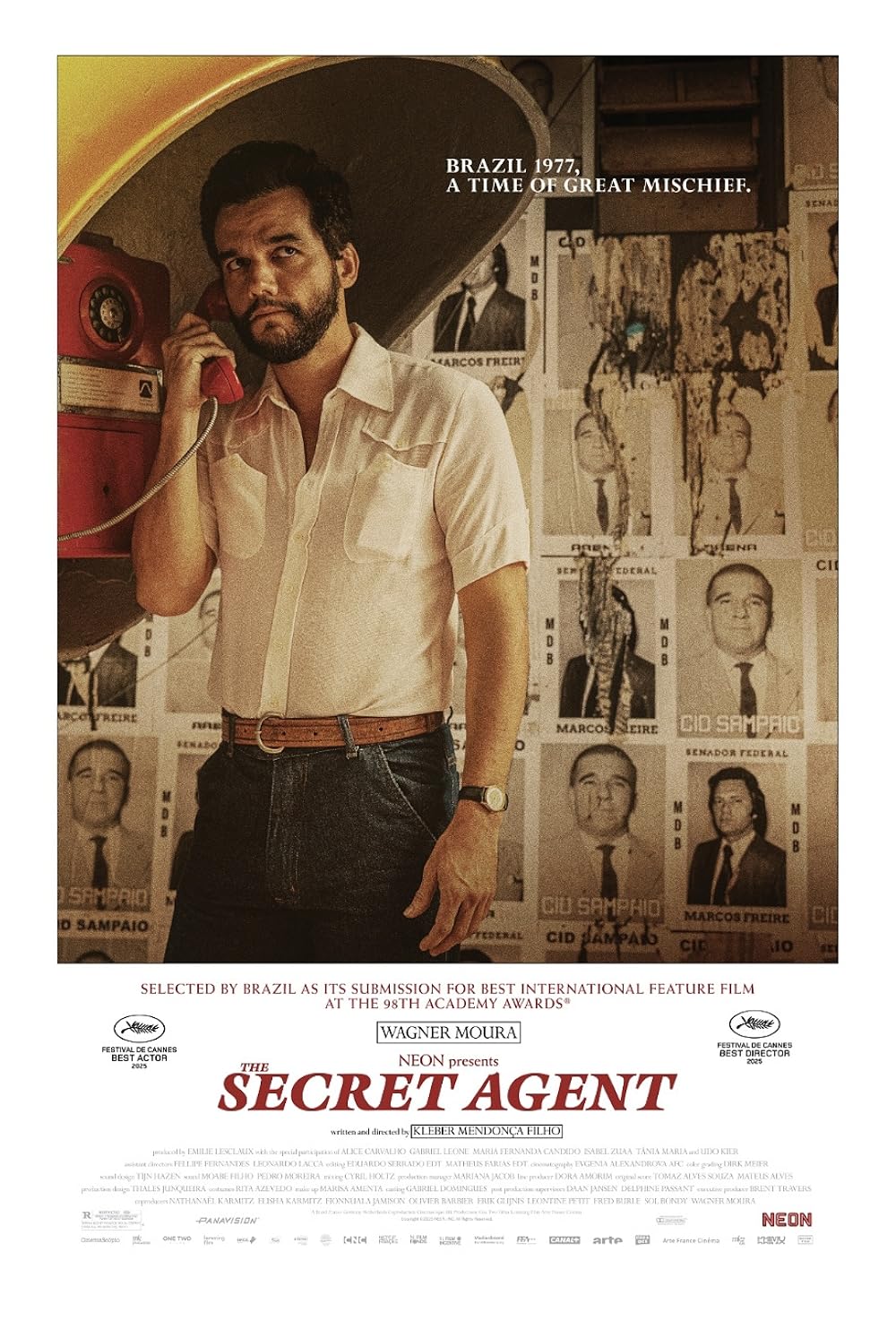
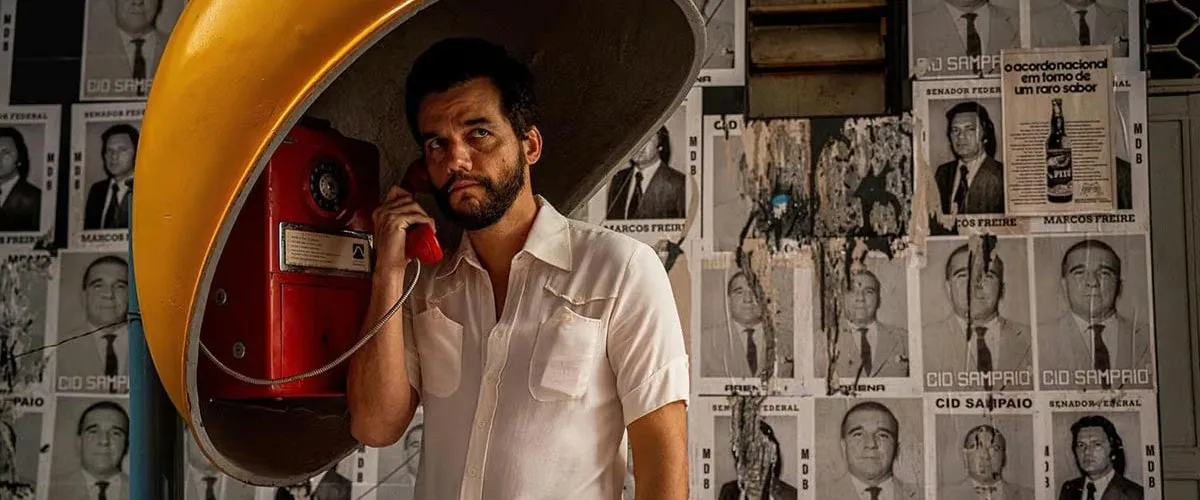
Once in a while, you see a movie that doesn’t feel made, but extracted from a dreaming mind. It has a strong personality and visual style and moves to its own mysterious rhythms. It won’t go to you and hand over its meanings. You have to go to it. That’s “The Secret Agent,” written and directed by Kleber Mendonça Filho (“Aquarius,” “Bacurau”).
Set in 1977 Brazil, roughly at the midpoint of a 21-year military dictatorship, “The Secret Agent” is a drama, a satire, an intriguingly laid-back espionage film, and a recreation of a time and place, with expressionistic and surreal flourishes that must be accepted on their own terms. Wagner Moura stars as Marcelo, a tall, bearded fellow with gentle energy and sad eyes. He arrives in Recife, the state capital of Pernambuco, Brazil, in a bright yellow Volkswagen Beetle. We don’t know why he’s come to Recife. We won’t know for a long time. You have to pick up on subtext in order to understand certain conversations. Marcelo and the other characters in his orbit try to avoid saying exactly what they mean, because someone might be listening.
Murder is everywhere. Some deaths are punishments, levied against the regime’s opposition. Others are byproducts of street crime. There’s a lot of overlap. Hired killers are free agents who will murder a stranger and dispose of the corpse—whether the client is the state, a corporation, or some random person with a grudge—then have a nice dinner and go to bed. This film is partly about how people accept a world where such things can happen, and learn to move within it.
We meet Marcelo in an opening sequence so beautifully shaped that it might work as a self-contained short film. On the outskirts of Recife during the yearly Carnival, Marcelo pulls into a run-down country gas station to refill his tank. Nearby is a fly-strewn corpse partly covered by a sheet of cardboard The image evokes masterworks by some of the most greatest chroniclers of authoritarian madness: Franz Kafka; the existential-experimental French-Argentinian author Julio Cortazar; Spanish surrealist filmmaker Luis Buñuel. When wild dogs check out the corpse, you wouldn’t be surprised if one of them made off with a hand.
The attendant on duty tells Marcelo that the dead man tried to steal cans of motor oil the night before and was shotgunned by the night clerk. Two cops drive up. They aren’t interested in the corpse. One of the cops “inspects” Marcelo’s beetle, poring over every inch of the vehicle in search of a violation. Finally, he asks Marcelo to donate to the “Policeman’s Carnival Fund” in lieu of a fine. Cash preferred. When Marcelo is finally allowed to drive away, the film cues up Chicago’s “If You Leave Me Now,” one of many seemingly counterintuitive soundtrack choices that burrow beneath the hero’s placid facade. As he finishes his drive to Recife, the song and Maura’s eyes communicate the hero’s contradictory emotions: longing, nostalgia, fear.
The rest of ‘The Secret Agent” builds on that brilliant opening. It’s a fastidiously elegant nightmare. Corruption, disregard for truth, and indifference to suffering are common in this world. Whatever Marcelo is up to, we know he’ll need to stay hyper-alert for danger. He shouldn’t even be checking in on his young son, Fernando (the adorable Enzio Nunes), who has been left in the care of Marcelo’s former in-laws and lives in Recife. But he’s a dad, so he takes the risk.
Each new player is so sharply rendered that they could be the protagonist of their own movie. Marcelo’s contact in Recife is 77-year-old Dona Sebastiana (Tânia Maria), a tiny woman with a sandpapered voice, introduced while walking down an alleyway, smoking a cigarette. A pair of hitmen hired to kill Marcelo, the gruff elder Agusto (Roney Villela), and his young and too-nosy partner Bobbi (Gabriel Leone), have a father-son dynamic even before we’ve learned any details of their lives.
At one point, Bobbi and Agusto turn to another deadly criminal to help them find and kill Marcelo: Vilmar (Kaiony Venâncio), an angular, unhealthy-looking man with dark eyes and an air of desperation. Venâncio is a late addition to the ensemble but makes a powerful impression. His Vilmar is intelligent and self protective but incapable of turning down an assignment because he needs the money, and also perhaps because turning it down would gnaw at his sense of honor. He could be a side character in one of those sweaty, hellish westerns in which no one’s conscience is clean.
Dona Sebastiana’s upstairs neighbor is a beautiful single mother named Claudia (Hermila Guedes). The old lady’s stories about Marcelo intrigued Claudia enough that she developed a crush on him from afar. Her casual fling with Marcelo is refreshingly adult. Sexually, it’s very 1977: comfortably carnal and far from committed. The relationship also one of many story elements tied to absent parents or children. Some died of natural or unnatural causes. Others simply exited a family unit for their own reasons. Marcelo’s own mother apparently disappeared. That’s why he spends time at a government-issued ID office, digging through their archives. Marcelo himself is widowed. His job makes it impossible to safely raise his son, so the boy lives with his late wife’s parents. The interactions between father and son are heartbreaking in their unaffected innocence, especially when Fernando asks dad when Mom is coming back. (As Chicago sings, “If you leave me now, you take away the biggest part of me.”)
Mixed reviews of “The Secret Agent” have called it disjointed or meandering, and criticized aspects as random and self-indulgent. Among them: a subplot about a murder victim whose leg was found in the belly of a tiger shark. The leg gets wrapped up like a roast and dumped in the sea by another set of criminals, Arlindo (Italo Martins) and Sergio (Igor de Araújo), but revives itself (in the form of a stop-motion model) and terrorizes men cruising a public park. We should take this sequence seriously but not literally, like the moldered leg in the shark’s stomach. The authoritarian state is an apex predator that remains unseen until it rises from the depths and chews people up. Little Fernando is obsessed with “Jaws,” which was still playing in Brazilian cinemas in 1977. This material seems all of a piece with the script’s dream logic, which is rooted in reality even when it seems to depart from it.
This is one of the year’s best films, and one of the most distinctive. I saw it three times, something I rarely do with new movies because there’s so much out there to see. With each viewing it deepened, and hit harder. The haunting ending raises the film (and Moura’s stellar lead performance) to another plane. If you’re willing to bend with the story, “The Secret Agent” will take you places movies rarely go.